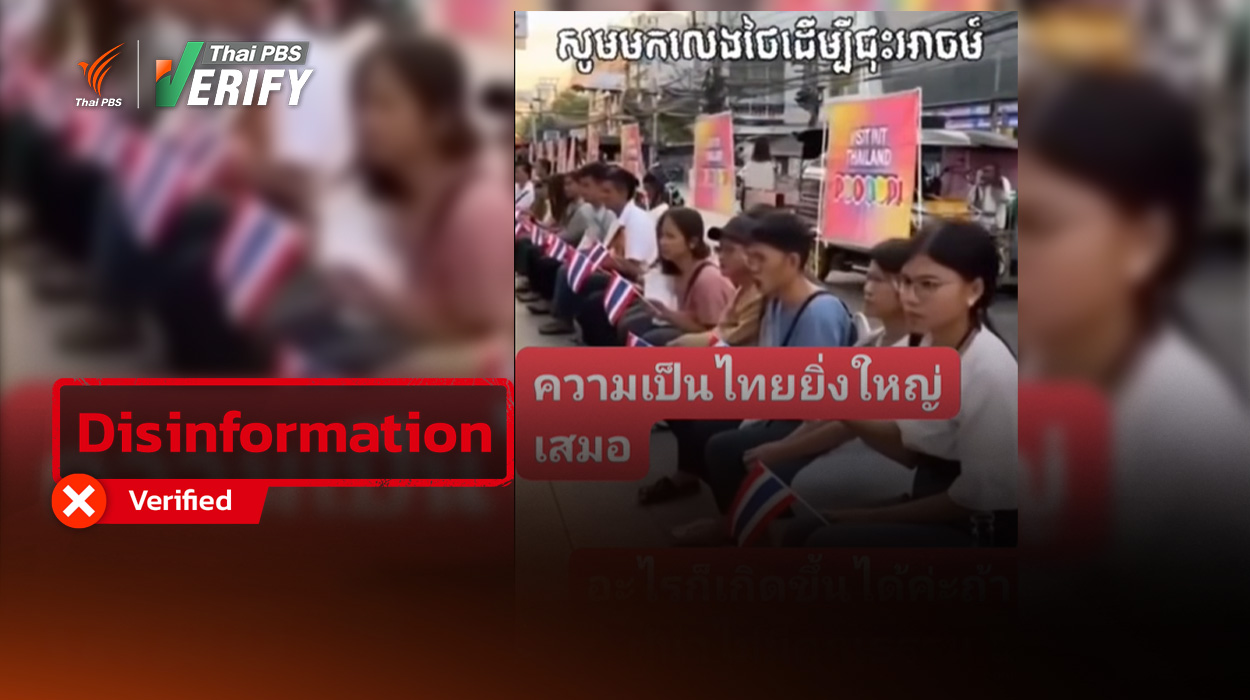
Thai PBS Verify found the source originated from: Facebook.
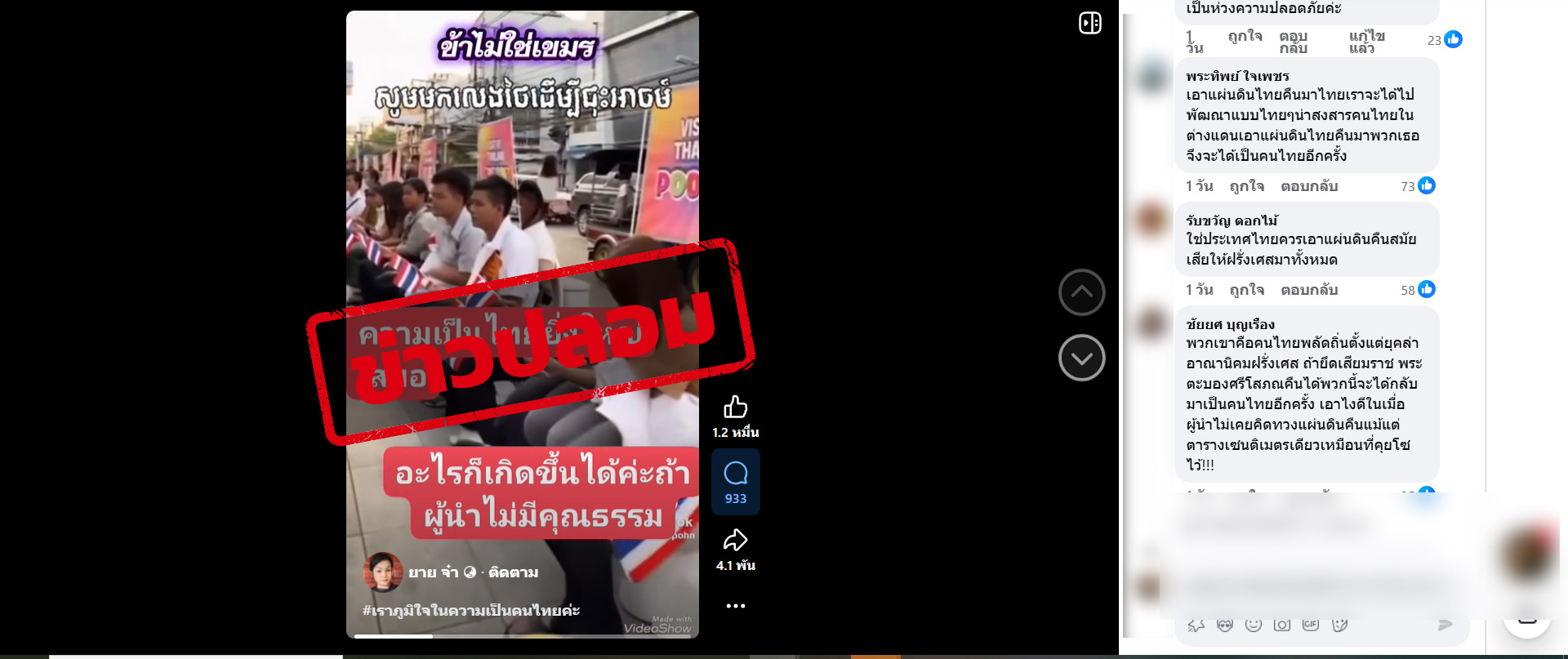
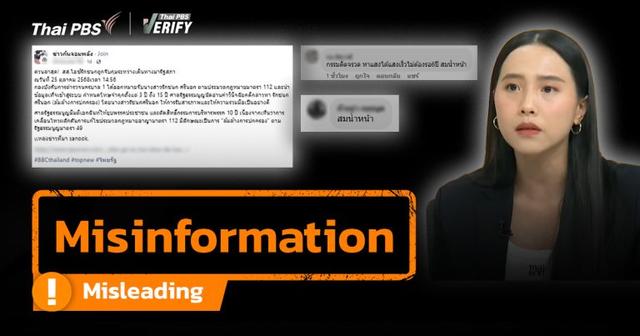
An investigation discovered a clip claiming that Cambodian people of Thai descent gathered to protest over land rights, asserting they had historically been assimilated and wanted to return to their roots as Thai people. In the clip, people are seen holding the Thai national flag while sitting on a toilet. The post garnered over 12,000 likes, 921 comments, and 4,000 shares, with the caption: “We are proud to be Thai.”
The video clip contained the following captions:
We are Thai people, relatives of the Northeast region. We lost independence when the French seized it. I am not Khmer. We await Motherland’s help to return. We are Thai people. Motherland, help us.
Along with a voice-over narration in the clip stating that dissatisfaction over land rights escalated into a significant regional issue when a group of demonstrators held the Thai national flag and publicly shouted that they were Thai, descendants of the Northeastern people who had been assimilated since the colonial era. Images of these events were broadcast via live streams and popular applications, causing panic across the region. Several clips showed groups of protesters in traditional dress, firmly holding the Thai flag (Trairong) and shouting, “We are truly Thai people, we are returning to our roots.” The incident forced Hun Sen to take immediate action. The Cambodian supreme leader thus issued an urgent order for security officials to immediately control the situation. Arrests and containment operations were conducted, and orders were given to remove all clips from the internet within a few hours, while also alleging foreign third-party interference aimed at creating internal divisions.
However, several Thai academics in the history field have stated that the sentiment among some Cambodians claiming Thai descent is not new, as the area of Thailand’s Northeast and the Cambodian border has been a region of cultural, linguistic, and kinship exchange for generations. “Some Cambodian citizens still feel they are children of Siam rather than subjects of Phnom Penh.”
Is the clip of Cambodian people of Thai descent protesting a real clip?
Upon watching this video, several irregularities are evident, suggesting that the content was generated by AI.
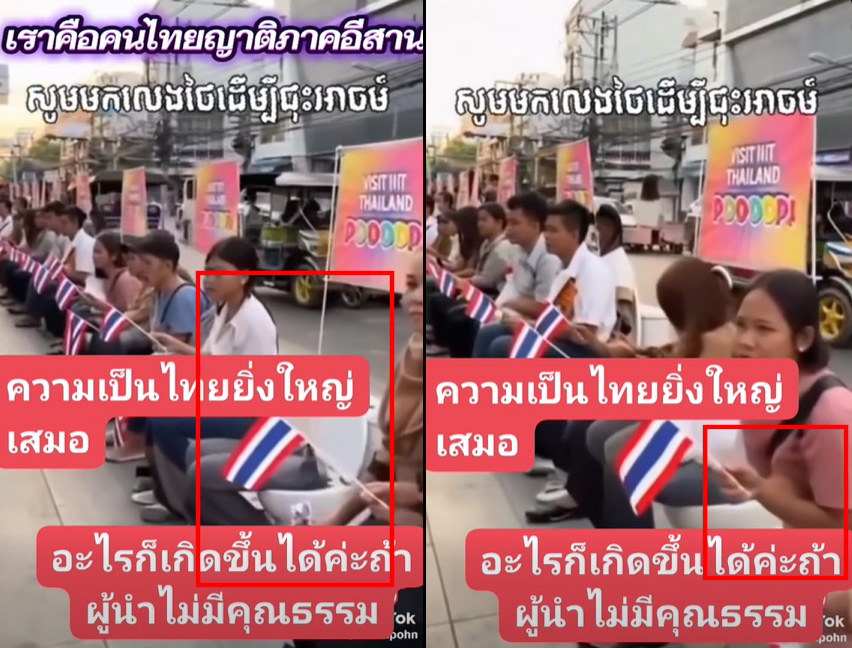
The left image shows only legs without a torso, while the right shows a torso but no legs. This suggests that the said video was likely created or modified by AI.
When parts of the video clip were checked using the AI content verification tool on deepware.ai, it was found that the video is also likely to have been created by AI.
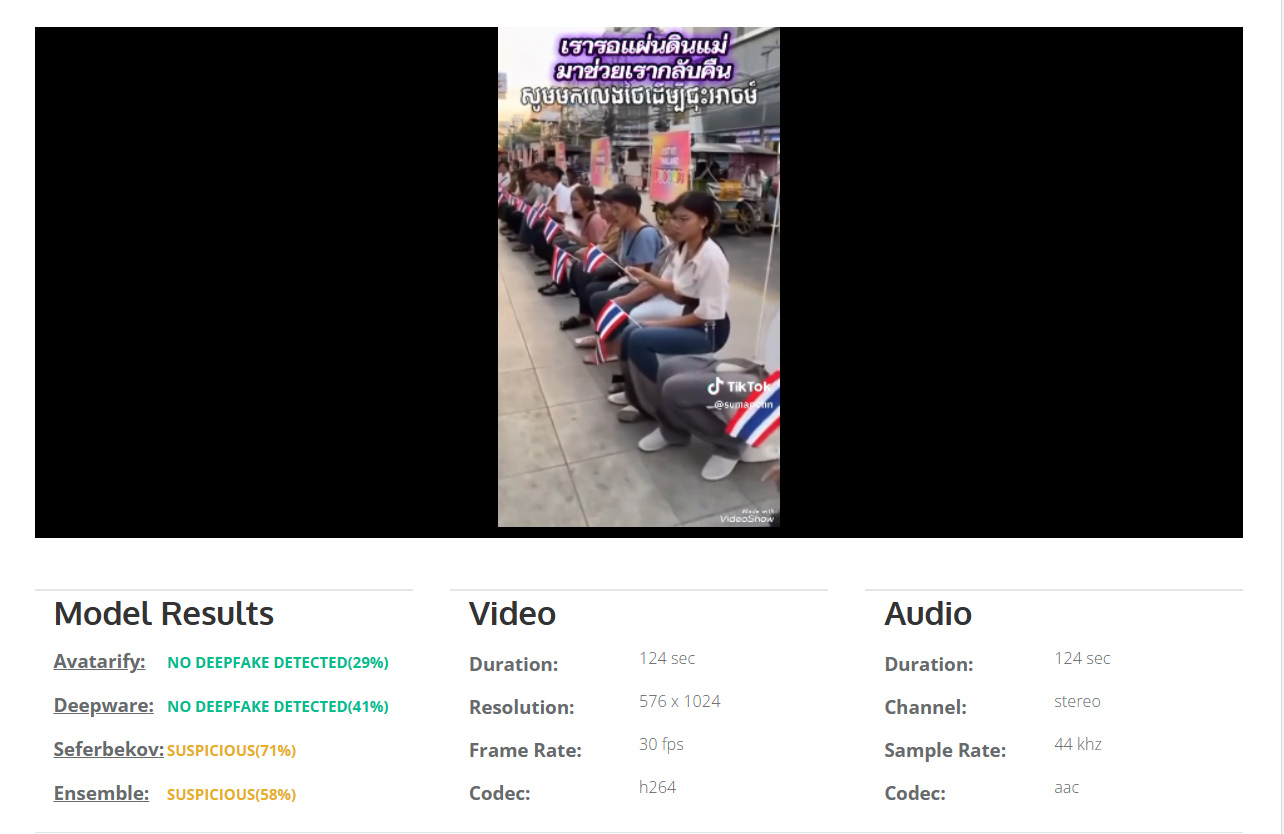
Image showing model results: seferbekov: Suspicious (71%), Ensemble (Total from all models): Suspicious (58%)
Meanwhile, Sathapon Patanakuha, CEO of Guardian AI, confirmed to Thai PBS Verify that the clip was created by AI, noting that the audio used for narration lacked fluidity and that the individuals’ movements appeared unnatural. Furthermore, the appearance of people in the images was abnormal, such as missing torsos or appearing only as legs.
Areas of Thai-Cambodian and Cambodian-Thai Mixed Residents
By the way, the areas along the Thai-Cambodian border feature populations with mixed ancestry and interconnected ethnic ties, particularly in Thailand’s Northeastern region along the Phanom Dong Rak mountains
Moreover, during the Cold War era, particularly the Khmer Rouge period, there were migrations of Cambodian people who settled in Thai border areas such as Surin, Buriram, and Si Sa Ket. Some of these groups are known as “Khmer Lue” (Thai-locale Khmer) and maintain kinship ties with Thai people on the opposite side of Cambodia.
And between 1979 and 1993, the Thai government, in collaboration with international organizations, especially the United Nations (UN) and the United Nations High Commissioner for Refugees (UNHCR), established several refugee camps along the Thai–Cambodian border to accommodate Cambodians fleeing the civil war. More than 300,000–400,000 refugees resided in these camps.
When the situation in Cambodia eased in the early 1990s, approximately 360,000 refugees returned to the country. In contrast, thousands of others chose to settle in Thailand, particularly in the border area of Sa Kaeo Province and the Lower Northeast. These areas later developed into semi-permanent communities, such as Nong Chan, Nong Ya Kaew, and Khok Sung in Sa Kaeo Province.